

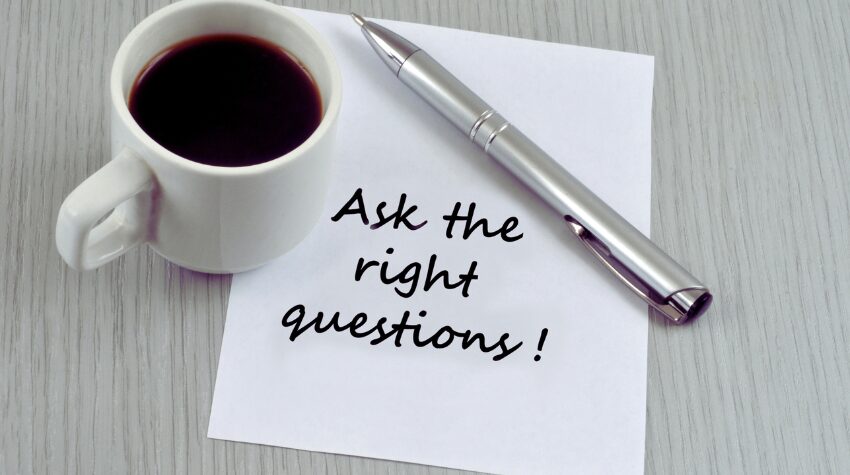
I’ve been thinking a lot about how often we make financial decisions without asking enough questions. It’s something I’ve caught myself doing more than once — just assuming “this must be how it works” and accepting whatever is in front of me without stopping to ask for clarity or explore other options. And every time I look back, I realize how much better that decision could’ve been if I had simply spoken up.
But over time I learned something important: when you share your situation openly or ask for guidance in the right places, you uncover answers, alternatives, and explanations you didn’t even know existed. Information that completely changes the quality of your decisions.
And that contrast — between what we accept by default and what we discover when we actually ask — is what inspired this article. Because not asking the right questions has a cost. A very real one.
- When you don’t ask, you decide blindfolded
Most people don’t consciously avoid asking questions. They simply assume there’s nothing to ask. They think the terms are fixed, the options are limited, and the offer in front of them is the only path.
The truth is the opposite.
Behind every rate, every fee, every condition, every timeline, there is context — and often flexibility. But you only see it if you ask.
Not asking leads to predictable pitfalls:
- accepting rates misaligned with your real profile,
- paying unnecessary fees,
- missing out on better products or structures,
- assuming timelines or conditions that were never actually fixed,
- choosing the first option simply because it was presented first.
It’s not ignorance.
It’s lack of information — and information rarely arrives uninvited.
- Asking questions is not being difficult — it’s being strategic
There’s a misconception that asking questions makes you annoying, demanding, or “too much.”
In reality, the opposite is true.
Professionals —good ones— want you to ask. It tells them:
- you care about the decision,
- you want to understand the implications,
- you’re engaged,
- you’re making an informed choice.
And here’s the truth people rarely say out loud:
the best financial outcomes almost always go to the people who ask.
Not because they negotiate aggressively.
Not because they know more.
But because clarity protects you — and confusion costs you.
Asking isn’t confrontation.
It’s self-protection.
- The questions few people ask — and that change everything
You don’t need financial jargon.
You don’t need a script.
You just need to ask questions that reveal the full picture.
Here are the ones that move the needle the most:
- “What other options do I have?”
This single question opens doors. There is always more than one option — but most people never know that because they don’t ask.
- “What would you do if this were your decision?”
You’d be surprised how often the answer shifts when the question becomes personal.
- “What am I not seeing here?”
Fees, penalties, timing issues, better alternatives — this question uncovers them all.
- “Can you walk me through the pros and cons of this?”
People love to explain. Let them. You’ll learn more in three minutes than in three hours of Googling.
- “What happens if I wait, compare, or adjust something?”
Timing changes everything. Many people lock themselves into pressure they didn’t need to accept.
These questions require zero expertise — only curiosity.
- Asking gives you power: more options, more clarity, more confidence
When you start asking the right questions, you stop operating on autopilot. You stop signing things you don’t fully understand. You stop assuming you have no control.
Asking does three things immediately:
- It expands your choices.
You go from one option to several — often dramatically better ones.
- It exposes hidden details.
Things you were never told suddenly become clear simply because you asked.
- It strengthens your decisions.
You stop feeling like you’re “hoping for the best” and start feeling like you’re choosing with intention.
And that shift —from passive acceptance to informed decision-making— is one of the most empowering financial transitions a person can make.
- Not asking has a cost — and you pay it every time
Silence is expensive.
Not asking costs:
- money,
- time,
- peace of mind,
- negotiating power,
- and the chance to choose what truly serves you.
Most people don’t lose opportunities because they’re irresponsible.
They lose them because they assumed they had none.
The truth is that options don’t magically show up.
You reveal them by asking.
Final Reflection: Your questions shape your financial outcomes
The quality of your decisions depends on the quality of the information you have — and information only appears when you ask for it.
Asking doesn’t make you difficult.
It makes you informed.
It makes you confident.
It makes you in control.
And most importantly, it protects you from accepting limits that were never real.
Your money works better when you speak up.
Your options expand when you ask.
Your future gets clearer the moment you stop assuming — and start questioning.