

I’ve been back from Italy for almost two weeks.
It feels like two months.
That’s the cruel thing about a great vacation — you blink and you’re back at your desk wondering if it actually happened. The emails don’t care that you were in Calabria. The pipeline doesn’t pause for gelato.
One thing that keeps reminding me the trip was real is the scale in my bathroom.
Let’s just say I did not hold back in Italy. The food was too good. The coffee was too good. And I have the evidence to prove it.
So I came home motivated. More motivated than before I left, actually — which is saying something because I was already trying to shed a few pounds before the trip.
Here’s where it gets interesting.
I decided to put my trust in AI.
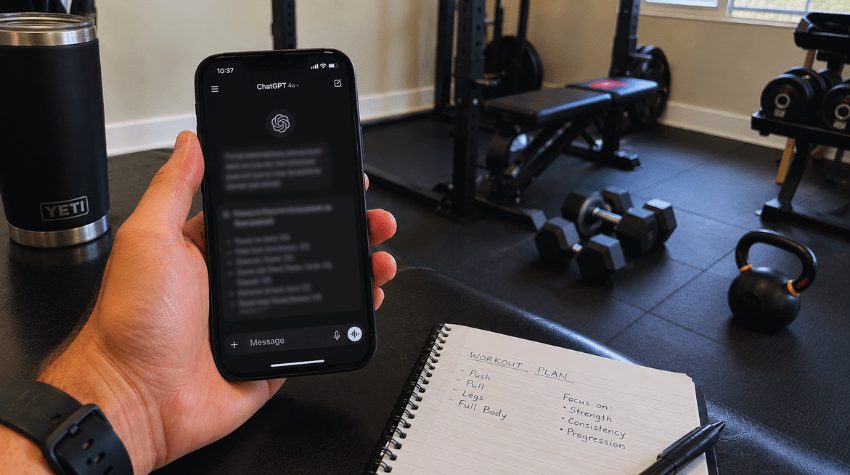
I asked ChatGPT to act as my personal trainer. It asked me a series of questions, I uploaded a photo of my workout area and equipment, and it built me a dynamic training plan tailored specifically to me. Dynamic because I give it feedback after every workout and it adjusts the plan accordingly. It evolves as I do.
On the diet side I downloaded an app called Lose It. You simply take a picture of your meal and it calculates and tracks the calories. The accuracy is genuinely impressive.
And it’s free.
The verdict is still out on whether this will work — I’m a big believer in having real people in your life to keep you accountable. But I’ll say this: what I’m getting from these tools used to cost $75 an hour for a personal trainer and $50 a month for a program like Weight Watchers. That’s a real number. And it’s gone.
I’m not saying AI replaces everything. But it’s worth paying attention to what it’s already replacing.
That last thought has been on my mind a lot lately — paying attention to what’s quietly changing around you before it becomes obvious.
August 19th is two weeks away. That’s the date the US has announced 50% tariffs take effect on a broad range of Canadian goods — well beyond the industries cited as justification. Building materials, food products, manufactured goods, agricultural products. The scope is wide.
Windsor knows this story better than most. We’ve been living the automotive version of it for over a year. But what I’m watching now is something slightly different — and I think it matters for anyone doing business in this region regardless of their industry.
Lenders are going quiet on Windsor.
Not publicly. No bank is going to issue a press release saying they’re pulling back from a market. That’s not how it works. But you can feel it in how deals are moving — or not moving.
I was working on a large commercial deal recently. Forty million dollars. No automotive exposure. No direct tariff impact. The kind of file where under normal circumstances the credit concerns are speed bumps — things you address, work through, and move past.
I did exactly that. Addressed every objection. Worked through every concern. The lender ran out of reasons to say no.
And then he said it anyway.
His exact words were something to the effect of: there’s just no way his bank is doing a $40 million commercial deal in Windsor right now.
Not the deal. Windsor.
That’s sentiment, not underwriting. And sentiment is harder to argue with than credit risk because there’s nothing to fix. The deal didn’t change. The market perception did.
I want to be clear — this dynamic isn’t unique to large deals. I’m seeing the same shift in thinking trickle into smaller files too. It’s not about the dollar amount. It’s about where lenders are comfortable putting their money right now. And Windsor, fairly or not, is on the wrong side of that conversation at the moment.
Here’s my honest take on what comes next — and I’ll be transparent that nobody actually knows.
My gut says August 19th either gets delayed again or gets partially negotiated down before it lands. But here’s what I’ve come to believe: the uncertainty itself may be doing more damage than the tariffs would. Businesses pausing.
Lenders tightening. Deals not getting done. Investment being deferred. All of that is happening right now — before a single new tariff takes effect.
If that’s by design, it’s an effective strategy. Cripple the economy with the threat rather than the thing itself.
Which means waiting for clarity before making decisions may be exactly the wrong approach. Because the clarity might not come. And the businesses that come out ahead on the other side of this won’t be the ones who waited — they’ll be the ones who kept their eyes open, stayed informed, and didn’t let uncertainty make the decision for them.
The $40 million deal found another path. It always does.
Until next week,
Vince.
P.S. Two weeks into the AI fitness experiment. The scale has not yet confirmed that it’s working. ChatGPT remains optimistic. I appreciate the support.