

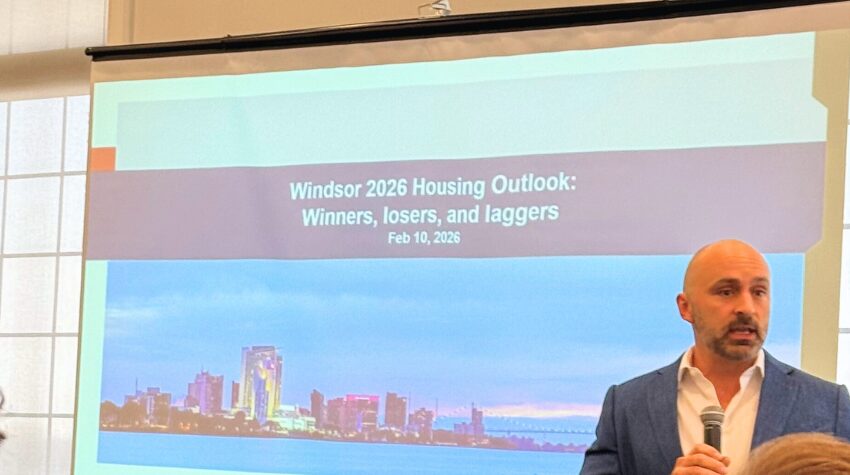
Last week I attended a presentation by Ben Rabidoux from Edge Analytics.
Thanks to Cody Kraus at Century 21 for bringing him to Windsor.
Ben is one of the sharper data-focused voices in Canadian real estate. For this session, he drilled into Windsor-Essex specifically.
But what struck me most wasn’t just the local data.
It’s that what’s happening here is a useful case study for what many mid-sized Canadian markets are experiencing right now.
We’re not in a boom.
We’re not in a crash.
We’re in a transition.
In Windsor, for example:
Home sales are still roughly 20% below the decade average.
Inventory is sitting nearly 60% above normal levels.
Prices are down about 11% from peak — far less severe than most major Ontario metros.
That’s not collapse.
That’s recalibration.
Across much of the country, the pattern rhymes:
- Volumes are depressed.
- Inventory has normalized or risen.
- Prices corrected but didn’t implode.
- Affordability is stretched.
But here’s the important part:
The bigger issue right now isn’t affordability.
It’s confidence.
Per capita sales across Ontario are below levels seen during the Financial Crisis. That simply isn’t sustainable forever.
There is pent-up demand building.
But people are waiting.
Waiting for rates to clearly drop.
Waiting for prices to clearly rise.
Waiting for headlines to say the worst is over.
Here’s where the money-system lens matters.
Housing markets don’t really move because prices look cheap.
They move because credit conditions stabilize.
Confidence follows credit.
Transactions follow confidence.
Prices follow transactions.
In transition phases, credit is available — but psychology is fragile.
That’s why sales can stay suppressed even when rates stop rising.
By the time confidence returns in the headlines, positioning has usually already shifted.
Another signal worth paying attention to:
Single-family housing starts are near multi-decade lows in many regions. Permitting activity nationally has fallen to levels not seen since the 1980s.
Future supply is being constrained quietly.
At the same time, the rental market is likely to stay well supplied as population growth cools and purpose-built completions hit the market.
Some segments are tightening.
Some are softening.
It’s not one simple story.
This isn’t a market that rewards prediction.
It rewards structure.
You don’t need to forecast whether sales rise 10–20% this year.
You need to understand:
- How exposed are you to renewal risk?
- How flexible is your equity?
- Is your mortgage structure built for a transition phase?
- Are you positioned for the next cycle — whatever form it takes?
Confidence returns slowly.
Structure can be built now.
If you want a clear view of how your mortgage, equity, and cash flow position fit inside this kind of environment, that’s exactly what Financial Clarity is designed for.
Not to force action.
But to make sure you’re positioned before confidence becomes obvious.
Until next week,
Vince
P.S. The market rarely rings a bell when the opportunity window opens.
It doesn’t announce itself.
It just slowly stops feeling uncertain.
And by then, the prepared are already moving.