

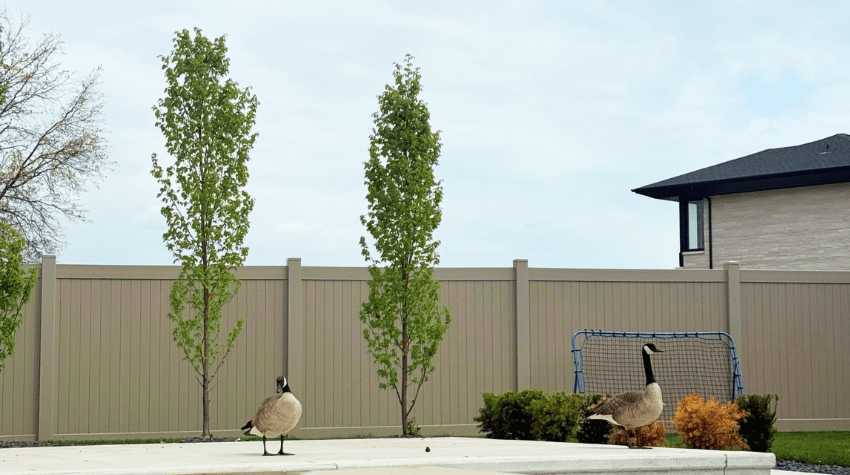
We have a Canadian goose problem.
It started innocently enough.
A pair of them would wander into the backyard, I’d go outside, wave my arms, and they’d fly off. No big deal.
Then something changed.
They stopped leaving.
Last week, all five of us were in the hot tub — middle of the evening — and the two of them landed about ten feet away and just… stood there.
Looking at us. Completely unbothered.
Like we were the ones intruding.
That was the moment I realized: they’ve gotten comfortable. They no longer see us as a threat. They’ve decided this is their yard now.
That was also the moment I decided — this is war.
I am now fully committed to spending whatever time it takes, power washer in hand, to make sure those geese never feel at home in my backyard again.
You cannot let them get comfortable. The moment you do, you’ve lost the yard.
Now let me tell you about a different kind of standoff I’ve been watching play out this week.
I talk regularly with former colleagues still working inside the banks and credit unions — account managers, commercial lenders, people on the front lines of these conversations every day.
What they’re telling me right now is worth paying attention to.
There’s a cycle in commercial banking that most business owners never see — until it affects them directly.
When the economy is healthy and loan books are performing, the sales side of the bank holds the power. Relationship managers can go to bat for their clients. Long relationships matter.
But when uncertainty hits — the credit room runs the show.
And when the credit room runs the show, everything changes.
Relationships carry less weight. A ten-year track record matters less than what your last twelve months of financials look like.
And if you operate in an industry the bank currently views as risky — anything with meaningful exposure to the CUSMA negotiations, for example — you can find yourself in their crosshairs through no fault of your own.
I’m hearing the same thing from contacts at every major institution.
Green, blue, red — doesn’t matter. The tolerance for deteriorating results is very thin right now. And it’s consistent across the board.
Here’s the part that keeps coming up in these conversations.
For years, holding “dry powder” — cash reserves, unused credit capacity, liquidity — felt like a bad idea.
Inflation was running hot. Money sitting idle was losing purchasing power by the day.
So what did business owners do? They put it to work. Real estate. Equipment. Other businesses. And a lot of the time, they used leverage to do it.
That wasn’t irrational. It was actually the right call for the environment they were in.
But environments change.
What protected you in 2021 — deploying capital aggressively, staying fully invested, using the leverage the bank was happy to give you — is exactly what makes you vulnerable today.
Because if your lender suddenly changes how they feel about your industry, you need options. You need flexibility. You need the ability to invest in your own business when the bank won’t.
And if you’ve used every dollar of reserve and every inch of credit capacity, you don’t have those options.
This isn’t a story about bad businesses or bad borrowers.
The people I’m talking about built real things. They made smart decisions for the environment they were operating in.
What’s changed is the context — not them.
But here’s what I know from being on the other side of this table: the businesses that come through cycles like this in the best shape aren’t necessarily the strongest on paper.
They’re the ones who saw the shift early enough to do something about it.
If you have meaningful exposure to any industry carrying real uncertainty right now — and you haven’t had a conversation about what your financing looks like in a tighter environment — that conversation is probably worth having before the bank initiates it.
Because unlike the geese in my backyard, you won’t always get a warning before someone decides the terms have changed.
Until next week,
Vince
P.S. The geese were back this morning. So was the power washer. Updates to follow.